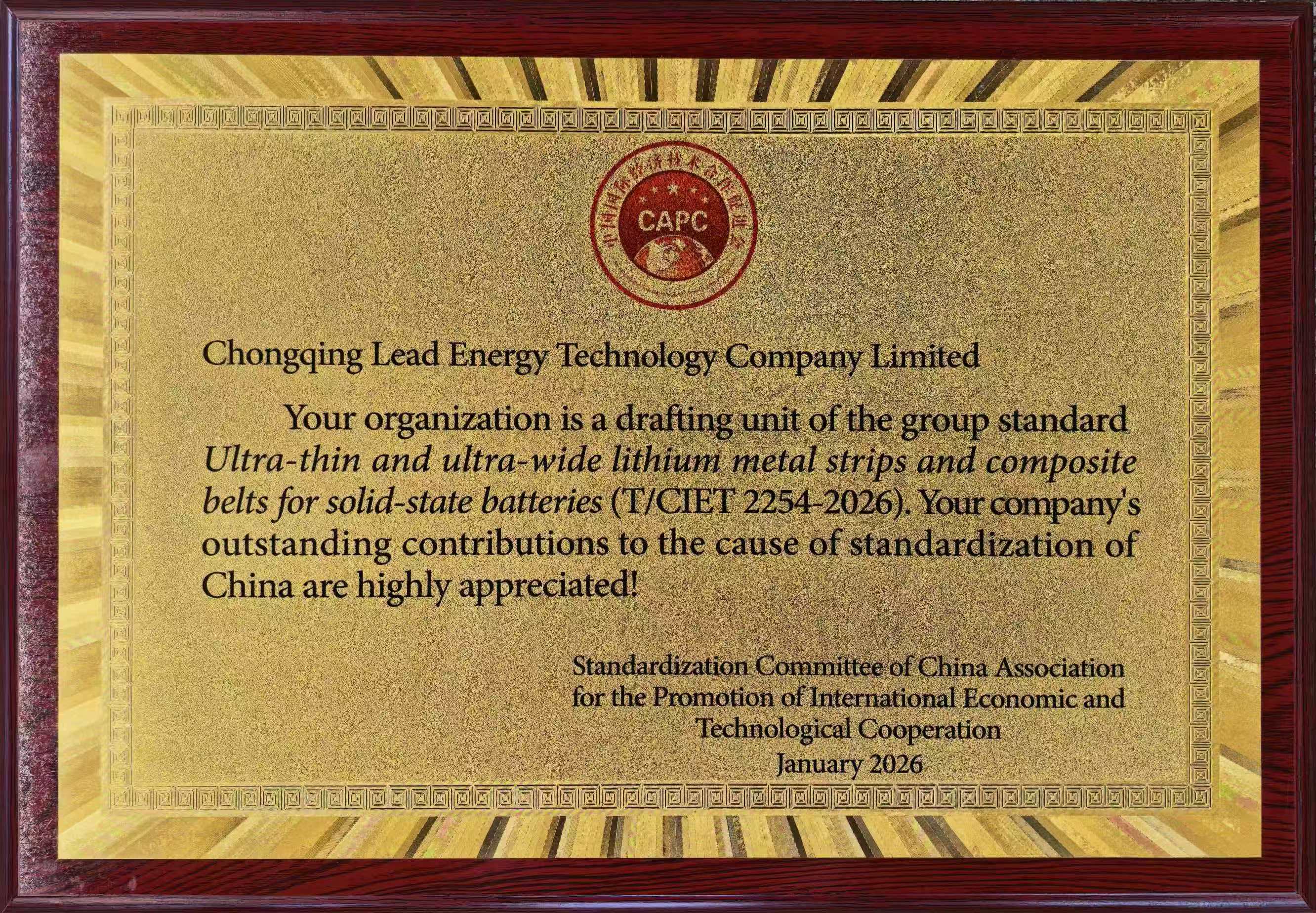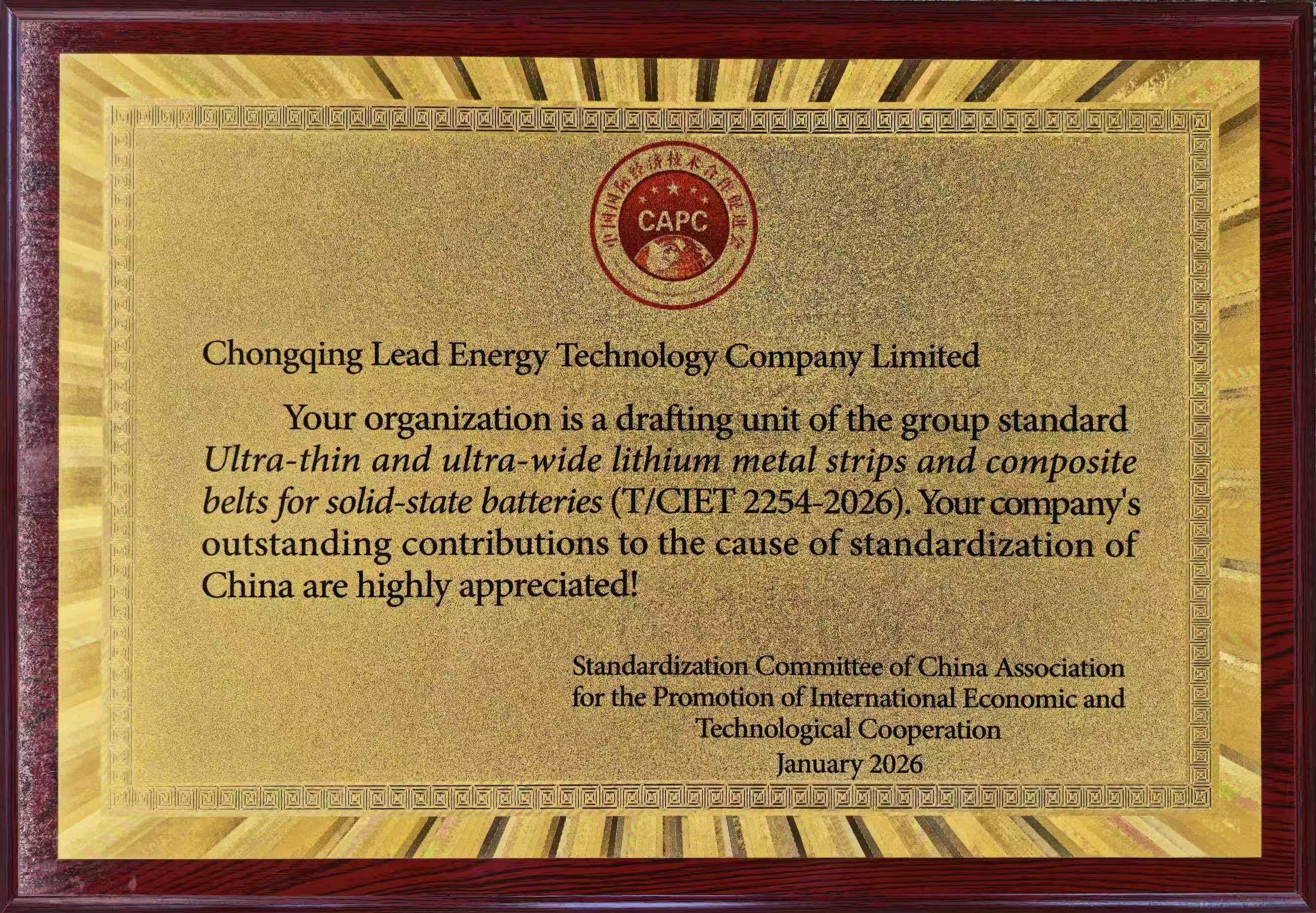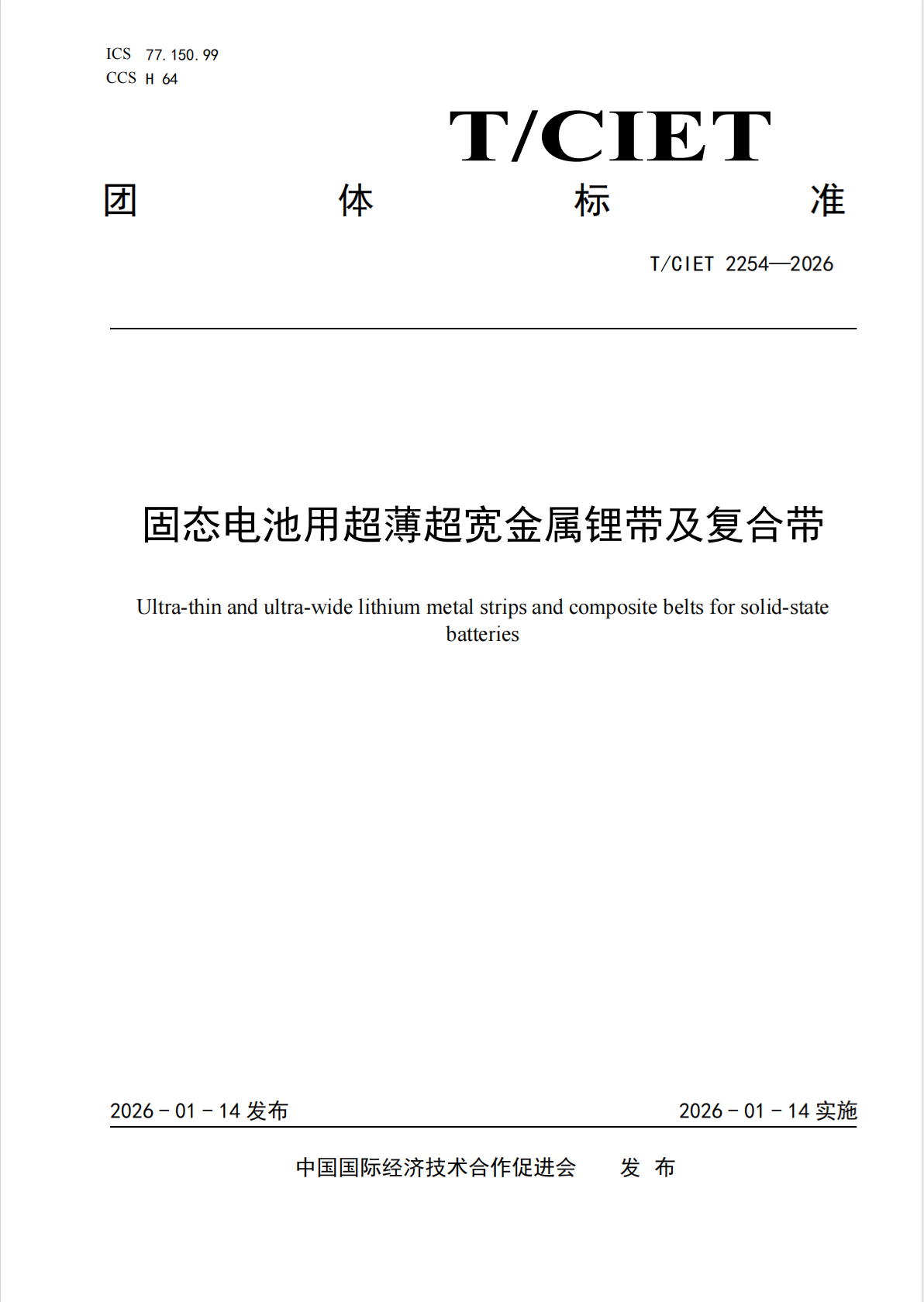
January 14, 2026 — Chongqing Lead Energy Technology Company Limited, a pioneer in high-performance lithium metal technology, is proud to announce the official release and implementation of the industrial group standard: Ultra-thin and ultra-wide lithium metal strips and composite belts for solid-state batteries (T/CIET 2254—2026).
Co-authored by LEAD in collaboration with leading technical institutions, this standard was officially published by the China Association for the Promotion of International Economic and Technological Cooperation. It fills a long-standing regulatory gap, providing the first unified technical framework for the next generation of solid-state battery (SSB) materials. As a primary drafting member, LEAD’s technical experts YUAN Ziqi and LU Yao played a pivotal role in defining the rigorous specifications required for high-energy-density batteries.
A Comprehensive Technical Framework for Next-Gen Anodes
This standard represents the first systematic effort to codify the technical requirements for materials essential to the solid-state battery ecosystem. It establishes authoritative guidelines and inspection methodologies for ultra-thin and ultra-wide lithium metal strips, lithium alloy strips (including Li-Mg and Li-Al), and lithium-copper composite belts.
The framework provides a unified technical basis for R&D, production, and quality control by defining the following core indicators:
Physical & Chemical Integrity: Systematic specifications for appearance and chemical composition.
Dimensional Precision: Critical standards for key dimensions (thickness and width) and areal density.
Surface & Interface Engineering: Precise requirements for surface roughness and interfacial bonding strength, ensuring compatibility with solid-state electrolytes.
Manufacturing Standards: Defined processing requirements and rigorous inspection methods.
Notably, the standard introduces groundbreaking requirements for "Ultra-thin" (down to 20μm) and "Ultra-wide" (up to 500mm) profiles, addressing the most demanding manufacturing challenges in the industry today.
"The adoption of T/CIET 2254—2026 is a major step toward the mass industrialization of solid-state batteries," stated ZHANG Xian, CEO of LEAD. "By establishing these benchmarks, we are providing our global partners with a unified language for quality and performance, accelerating the transition to safer, more efficient energy storage."
This milestone underscores LEAD’s role as an industry leader. By driving the standardization of ultra-thin and ultra-wide materials, LEAD is directly solving the manufacturing bottlenecks currently facing the EV and energy storage sectors. As a key architect of this standard, LEAD’s full suite of lithium metal products is already fully compliant with T/CIET 2254—2026, offering partners a de-risked and future-proof supply chain.
Commitment to High-Quality Development
Looking forward, LEAD will continue to leverage its proprietary equipment and manufacturing expertise to push the boundaries of lithium metal technology. We remain dedicated to providing our clients with the most advanced, reliable, and sustainable material solutions, co-creating a high-quality future for the new energy industry.